
Explore / Solution Focus

Solution Focus

Start with the pressure point. See how business choices, technology capabilities and practical first moves combine around the outcome that matters.

Focus before solution

Do not begin with a product.
Begin with the pressure.

What must become different?Service · Control · Flow · Insight · Scale

A technology discussion becomes useful when it is anchored to a business condition that leaders, teams and customers can recognise.

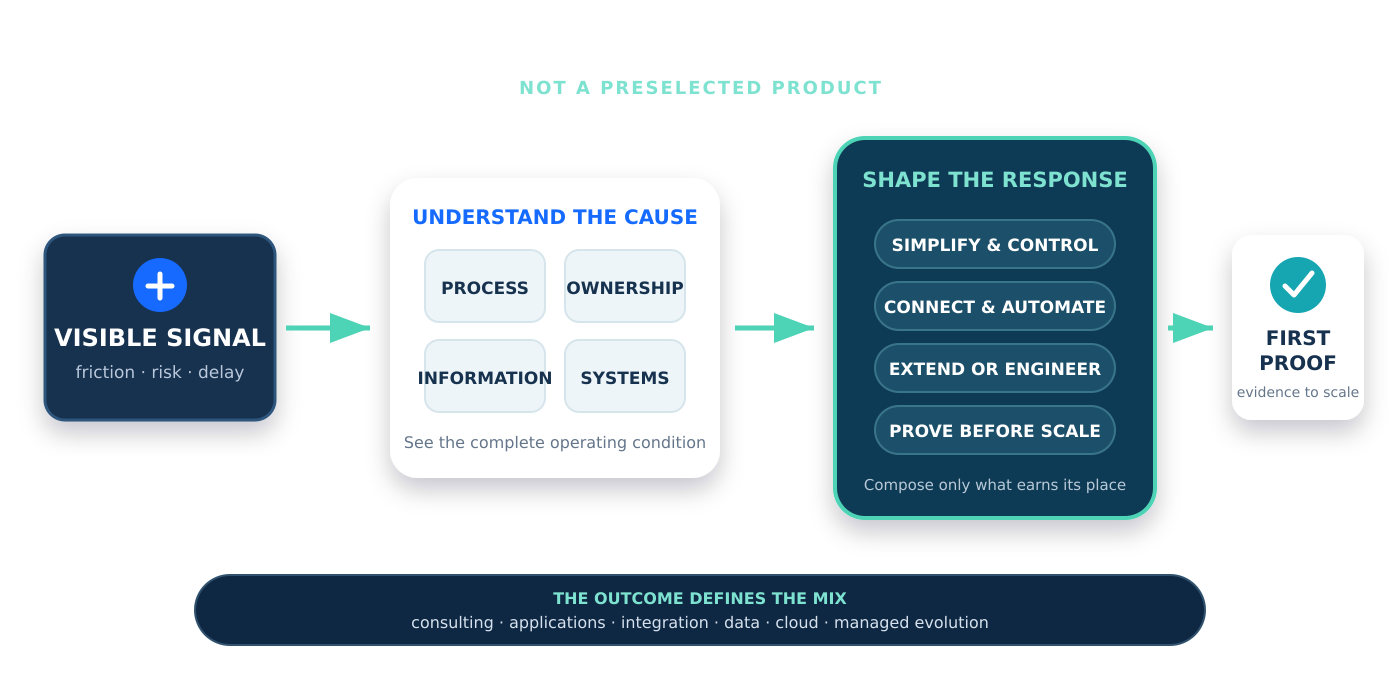
Solution Focus brings related challenges together so the response can be shaped around an outcome—not around a preselected platform. Each focus area combines consulting, engineering, integration, data, cloud and operational capability only where they add value.

The result may be a new application, a connected workflow, a modernised platform, a better use of what already exists—or a deliberate combination of these.

Our focus lens

One pressure point.
Four decisions before delivery.

This lens prevents a visible symptom from being treated as the whole problem.

01

Signal

What friction, risk, delay or missed opportunity is visible now?

02

Operating cause

Which process, ownership, information or system condition sustains it?

03

Response shape

What should be retained, simplified, connected, automated or engineered?

04

First proof

What contained move can demonstrate value and expose assumptions?

05

Scale decision

What evidence justifies adoption, extension or a change of direction?

Priority solution focuses

Recognisable business conditions.
Joined-up technology responses.

Select the situation closest to your reality. Each area begins with a business test and shows the capability mix likely to matter.

01

Connected operations

Work crosses functions, but information does not

Orders, cases, projects or service requests move through disconnected teams and systems, leaving people to reconcile progress manually.

Focus question
Where does flow break, duplicate or lose ownership?
Likely response
Shared process model, integration, workflow and operational visibility.
First proof
One end-to-end journey with accountable hand-offs and status.
ProcessIntegrationApplicationsInsight
02

Service experience

Customers or employees cannot complete the journey easily

People switch channels, repeat information or depend on internal intervention for routine requests, updates and knowledge.

Focus question
Which moments create avoidable effort or uncertainty?
Likely response
Portal, case orchestration, knowledge, communication and assisted service.
First proof
One high-value journey redesigned across front and back office.
ExperienceWorkflowContentCommunication
03

Control & evidence

Work happens, but assurance arrives too late

Approvals, obligations, evidence and exceptions are dispersed across email, files and informal follow-up.

Focus question
Which decisions must be traceable, timely and defensible?
Likely response
Controlled workflow, role-based access, records and exception visibility.
First proof
One control-intensive process with a complete evidence trail.
GovernanceAutomationSecurityRecords
04

Decision intelligence

Data exists, but action still depends on interpretation

Reports disagree, arrive after the decision or explain activity without showing the intervention required.

Focus question
Which decision must become faster, clearer or more consistent?
Likely response
Trusted definitions, integrated data, decision views and action loops.
First proof
One recurring decision connected to agreed evidence and ownership.
DataBIAIAction
05

Modernisation

Critical systems work, but constrain every next move

Legacy applications carry valuable process knowledge while creating security, support, integration or change limitations.

Focus question
What value must be preserved while constraints are removed?
Likely response
Estate assessment, workload disposition and phased modernisation.
First proof
One bounded workload moved or renewed with reconciliation evidence.
CloudEngineeringMigrationOperations
06

Scalable growth

The business has outgrown informal operating methods

Growth increases transaction volume, roles and complexity faster than spreadsheets, point tools and personal knowledge can absorb.

Focus question
Which operating backbone is needed for the next stage?
Likely response
Proportionate applications, shared data, controls and modular integration.
First proof
One commercial or operational cycle established on a scalable foundation.
ERP/CRMApplicationsControlsScale

The response is not predetermined

Use what fits.
Change only what earns its place.

Our role is to make the composition decision explicit, including the trade-offs.

RetainKeep dependable capability and remove unnecessary disruption.
SimplifyCorrect process and ownership before adding technology.
ConnectMake specialised systems operate as one coherent environment.
ExtendAdd focused capability around platforms already in use.
ReplaceEngineer or adopt a new foundation when constraints justify it.

A practical starting point

Bring one pressure point.
Leave with a sharper decision.

An initial focus conversation identifies the visible signal, the operating context, what has already been tried and the evidence that would make progress credible. From there, we can recommend a focused assessment, proof or roadmap.

Discuss your priority