
Customer relationships & revenue
Leads, opportunities, accounts, activities, quotations, campaigns, service cases and a dependable customer history.
Engage · sell · serveServices / CRM, ERP & Manufacturing
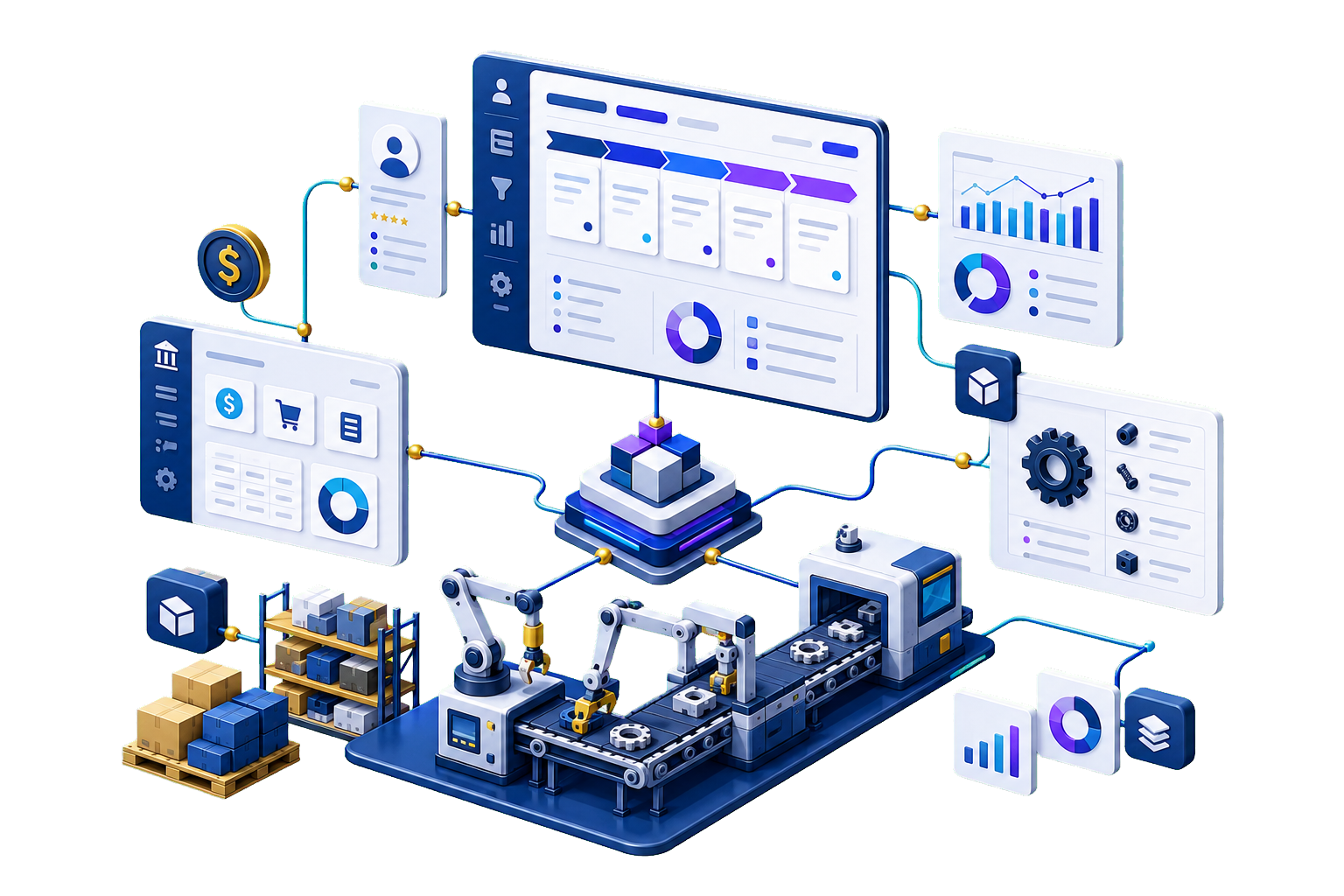
Connected customer, resource and production systems shaped around how the organisation sells, plans, supplies, makes, delivers and grows.
One connected operating picture
Enterprise systems create value when people can follow one trusted process and see the same operational truth—not when CRM, finance, supply and production remain separate islands.
ToqXcel helps organisations select, tailor, implement and connect CRM, ERP and manufacturing capabilities around their real operating model. We work with established platforms, specialist products and custom applications where differentiation demands it.
The result is a practical digital foundation that improves control today and can evolve as products, locations, regulations and business models change.
Distinct responsibilities, shared information
Each system has a clear role. Their greatest value appears when customer commitments, resources and production plans remain connected.
Leads, opportunities, accounts, activities, quotations, campaigns, service cases and a dependable customer history.
Engage · sell · serveFinance, purchasing, inventory, orders, projects, people, assets and the controls that coordinate the organisation.
Plan · transact · governDemand, bills of materials, material requirements, capacity, production orders, quality, costing and shop-floor progress.
Schedule · make · improveProcesses that cross departments
We design around end-to-end business journeys, clarifying ownership, decisions, data and exceptions at every hand-off.
Marketing, opportunity, quotation, order, fulfilment, invoice, payment and customer follow-up.
Demand, supplier selection, purchase approval, receipt, invoice matching and settlement.
Forecast, materials, capacity, schedule, production, quality, completion and finished stock.
Customer request, entitlement, assignment, communication, resolution and service insight.
Transactions, controls, close, consolidation, management accounts and regulatory reporting.
People records, onboarding, time, performance, learning, succession and workforce insight.
Manufacturing & material planning
Manufacturing capability is shaped around the product, process, plant and level of control required—from light assembly to more complex production environments.
Items, variants, bills of materials, routings, substitutions and controlled engineering changes.
Forecasts, orders, stock policies, material requirements, purchase and production suggestions.
Work centres, calendars, constraints, priorities and achievable production sequences.
Production orders, consumption, output, inspections, traceability, variance and actual cost.
A complete business foundation
Capabilities can be introduced in phases, integrated with existing systems and configured for different companies, countries, sites, currencies and responsibilities.
Accounts, pipelines, quotations, contracts, orders, cases, service levels and communication history.
General ledger, receivables, payables, cash, budgets, assets, tax, consolidation and audit-ready records.
Requests, approvals, quotations, orders, receipts, supplier performance and invoice matching.
Availability, locations, lots, serials, transfers, replenishment, picking and stock accuracy.
Resources, time, costs, milestones, workforce processes, maintenance and operational ownership.
Role-based workspaces, operational dashboards, KPIs, exceptions, forecasts and management insight.
Platform and architecture choice
We assess process fit, scale, regulatory needs, integration, internal capability, ownership cost and future change before recommending an approach.
Microsoft Dynamics 365, Business Central, Salesforce and other suitable enterprise products configured around the organisation.
Apps, portals, workflows and reports that extend a platform without forcing every differentiating process into its standard model.
Purpose-built ERP or operational modules where market products do not fit the process, scale or ownership requirement.
APIs, data services and governed synchronisation that let new and legacy systems work together during transition and beyond.
Adoption is part of implementation
Enterprise transformation succeeds when process, data, people and technology move together through a controlled programme.
Operating model, processes, controls, pain points and measurable outcomes.
Process design, fit-gap, platform, architecture, roadmap and business case.
Platform setup, extensions, integrations, security and data migration.
Testing, controls, training, cutover readiness and role-based adoption.
Support, monitoring, optimisation, releases and continuous process improvement.
Start with the priority
Begin with a focused conversation about the business requirement, current environment and outcome you need.